When you log into an e-commerce website and add an item to your cart, the website remembers you as you navigate from page to page. But did you know that the internet's core protocol, HTTP, is actually forgetful?
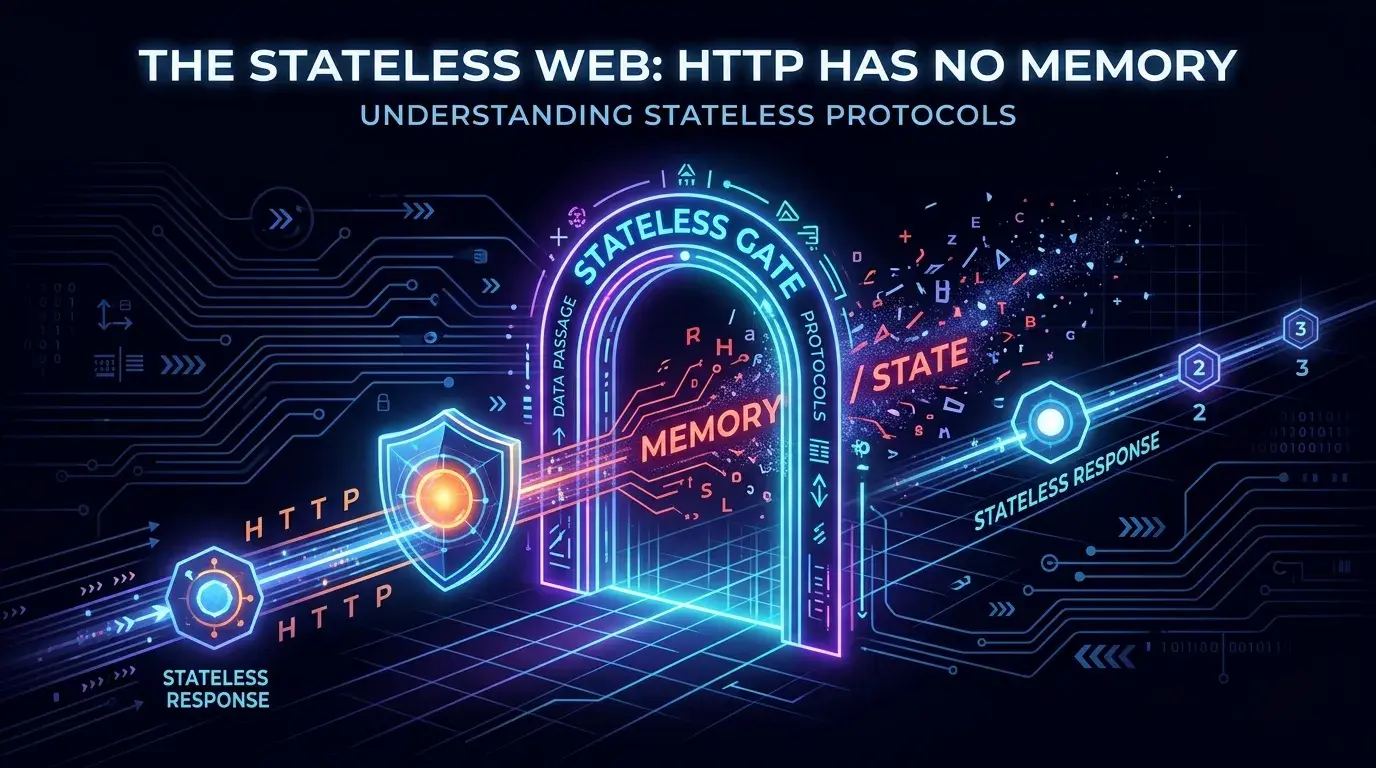
In web development, we say that HTTP is stateless. It has no memory. To HTTP, every request is a stranger.
Imagine walking into a coffee shop, ordering a latte, and telling the barista your name. Then you walk to the pickup counter and ask, "Is my latte ready?" The barista looks at you blankly and says, "Who are you and what did you order?"
That is exactly how HTTP works.
When you request the Homepage, the server sends it to you. When you click on the Contact page one second later, the server has completely forgotten that you just visited the Homepage. It treats every single request as an isolated event.
If the protocol itself doesn't remember anything, how do modern web applications keep us logged in or remember our shopping carts?
Developers use clever workarounds to give the web "memory". The most common methods are:
When you log in, the server sends a small piece of data called a cookie back to your browser. Your browser automatically attaches this cookie to every future HTTP request it sends. When the server sees the cookie, it says, "Ah, I remember you!"
Similar to cookies, but the heavy lifting is done on the server. The server stores your data (like your shopping cart) and just gives your browser a small ID badge (a Session ID) to hold onto.
Used heavily in modern mobile apps and Single Page Applications (SPAs). When you log in, you receive a digital signature (a token). You show this signature with every request to prove who you are.
Turning a stateless protocol into a seamless, highly personalized user experience is what separates basic websites from robust digital products. Managing state securely and efficiently is critical for e-commerce stores, SaaS platforms, and enterprise portals.
At Creativolks, we specialize in building complex, stateful web applications that feel fast and remember your users securely.
Need a custom web application for your business?
Let's talk about your project. Free consultation, no commitment.
Get a Free Consultation